
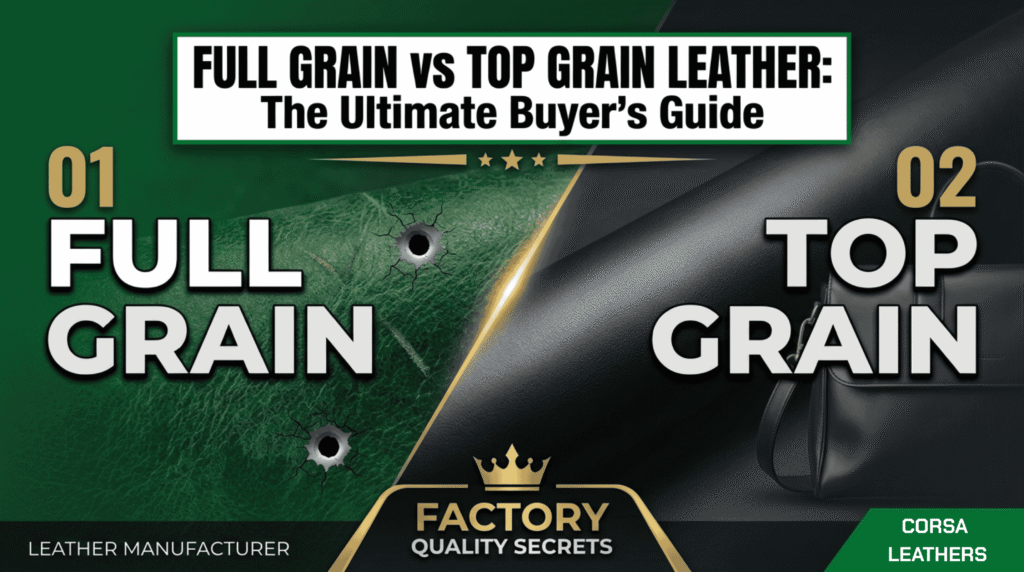
An informational infographic contrasting Full Grain and Top Grain leather, strictly based on the layout and text of the provided image.

Full Grain vs. Top Grain Leather Guide

8 Key Differences: Full Grain vs Top Grain Leather | Corsa Leathers Guide
Direct from Corsa Leathers Tannery

Full Grain vs Top Grain

⚠️ Avoid “Genuine Leather” Marketing!
It’s often the lowest grade of leather. For longevity, always stick to Full Grain or Top Grain.

PREMIUM LEATHER STANDARDS

Premium Quality

01. Full Grain

The strongest part of the hide. Un-buffed and natural, showing the unique “grain” and character. It develops a beautiful patina over time.

Top Tier

02. Top Grain

The upper layer split. Refined for a uniform look while maintaining high durability. Perfect for luxury handbags and fine accessories.

Finished Look

03. Corrected Grain

Buffed to remove imperfections, then embossed for a perfect texture. Offers a consistent, clean aesthetic for modern styles.

Swipe to Explore ➔
01. ORIGIN

Where It Begins

Full Grain leather comes from the top hide layer, keeping the natural grain intact. Top Grain has the outermost layer sanded off to remove blemishes.

02. QUALITY & COST

The Premium Standard

Full Grain is the highest quality grade available. It’s more expensive to procure and process, whereas Top Grain offers a thinner, more affordable alternative.

03. APPEARANCE

Natural Marks vs. Uniformity

Full Grain displays the animal’s unique life story through marks. Top Grain is sanded and imprinted with imitation grain for a consistent, uniform look.

Full Grain vs Top Grain Leather Comparison | Corsa Leathers

Full Grain vs Top Grain

10 KEY DIFFERENCES FOR PROFESSIONALS

Point Full Grain Leather Top Grain Leather
01. Origin Outer layer of hide (Unsplit) Outer layer (Sanded/Split)
02. Surface Natural marks & growth visible Smoothed & uniform appearance
03. Strength Strongest vertical fibers Strong fibers removed by sanding
04. Breathability High (Natural pores are open) Low (Blocked by finishes)
05. Aging Develops rich, unique patina Stays consistent/Artificial look
06. Durability Lifetime use (Decades) High (10-15 years)
07. Resistance Prone to stains (Absorbent) Stain resistant (Coated)
08. Flexibility Stiff at first, softens over time Soft and pliable from day one
09. Application Heavy-duty/Safety/Heritage High-fashion/Luxury Bags
10. Cost Most Expensive (Premium) Moderate (Value for brands)
04. AGING

Patina Perfection

Full Grain beautifies with age, developing a glossy patina. Top Grain’s finishing coat prevents this but offers better initial stain resistance.

05. DURABILITY

Built for Performance

Full Grain contains the strongest hide fibers. It’s the only choice for Moto Wear and heavy-duty gear.

06. CARE

Maintenance Routine

Both require conditioning. Top Grain is more stain-resistant, while Full Grain absorbs oils and moisture more readily, requiring quicker attention.

Leather Grading Guide

THE REALITY

Animal Life Matters

Leather is a natural product. Scars, bug bites, and herd fights create “imperfections” that determine the final quality grade of the hide.

HIGHEST QUALITY

Full-Grain Leather

Natural: Hair is removed, but the surface is NOT sanded or buffed.
Durability: Uses the entire thickness; strongest and most durable.
Aging: Retains oil-absorbing properties and develops a beautiful Patina over time.

SECOND HIGHEST

Top-Grain Leather

Processed: Top layer is sanded or “split” to remove surface blemishes.
Workability: Thinner and easier to use for handbags and faux finishes (Alligator/Snake).
Trade-off: Looks pristine but is weaker and won’t develop a true natural patina.

THE VERDICT

Informed Choice

If you want longevity and character, choose Full-Grain. If you want a uniform, pristine look for fashion, Top-Grain is the standard.

EXPERT KNOWLEDGE

FAQS

01

Is Full Grain Real?

Absolutely. It is the most authentic form of leather, retaining the hide’s natural surface and original protective layer.

02

Why the Premium Price?

Only the finest hides without major scars qualify. It is difficult to process and requires expert craftsmanship to stitch.

03

Will it Peel?

High-quality Full and Top grain leather never peel. Only cheap “Bonded” or synthetic leathers flake off like plastic.

04

What is Patina?

Over time, Full Grain develops a rich, glossy sheen. It doesn’t wear out; it matures and looks better with age.

05

Is it Waterproof?

Top Grain offers slight water resistance due to finishes, but all real leather should be kept dry to maintain its integrity.

06

‘Genuine’ Quality?

Be careful! In the industry, “Genuine” often refers to lower-grade split leather or leftovers bonded together.

07

How to Identify?

Full Grain shows natural pores and unique imperfections. If the texture is perfectly repetitive, it’s likely synthetic.

08

Does it Scratch?

Top Grain can show scratches easily because its toughest top fibers are sanded off during the correction process.

09

Lifespan Expectancy?

With basic conditioning, a Full Grain product is a legacy item that can last for 30 to 40 years or a lifetime.

10

Which is Best?

Choose Full Grain for durability and heritage character. Choose Top Grain for a sleek, uniform fashion finish.

Swipe Left for Next Card

Leather Care Guide

Expert maintenance tips to make your gear last a lifetime.

01

Keep it Dry

Never soak leather. If it gets wet, wipe it with a soft cloth and let it dry naturally. Avoid hair dryers or direct heaters.

02

Conditioning

Apply a high-quality leather balm every 6 months. This keeps the fibers hydrated and prevents cracking or stiffness.

03

Storage Tip

Store in a cool, dry place inside a breathable dust bag. Never use plastic covers as leather needs to breathe.

04

Avoid Sunlight

Prolonged exposure to direct sunlight can fade the color and dry out natural oils. Keep it in the shade when possible.

05

Cleaning Dust

Use a dry microfiber cloth for weekly dusting. For stains, use a damp cloth with mild, pH-balanced leather cleaner.

06

Natural Scratches

On Full Grain leather, small scratches can often be rubbed out with your fingertip—the natural oils help heal the mark.

07

Shape Retention

Don’t overstuff your leather bags or pockets. Overloading can permanently stretch the grain and ruin the silhouette.

08

Odor Removal

If your leather develops a smell, place it in a breathable bag with activated charcoal for 24 hours to absorb moisture.

09

Salt Stains

In winter, salt can ruin leather. Mix equal parts water and white vinegar to gently wipe away salt stains immediately.

10

Expert Check

Once a year, give your premium leather goods a professional deep clean to maintain their heritage value.

← Swipe for Care Tips →